.avif)
Google Ad Clicks, Zero Sales? It's Probably Not the Ad
A practical guide for business owners spending money on Google Ads but not seeing the return.
You launched your Google Ads. The dashboard shows traffic. The budget is moving. But the revenue hasn’t followed.
Before you touch your keywords or adjust your bids, look at where you’re sending people.
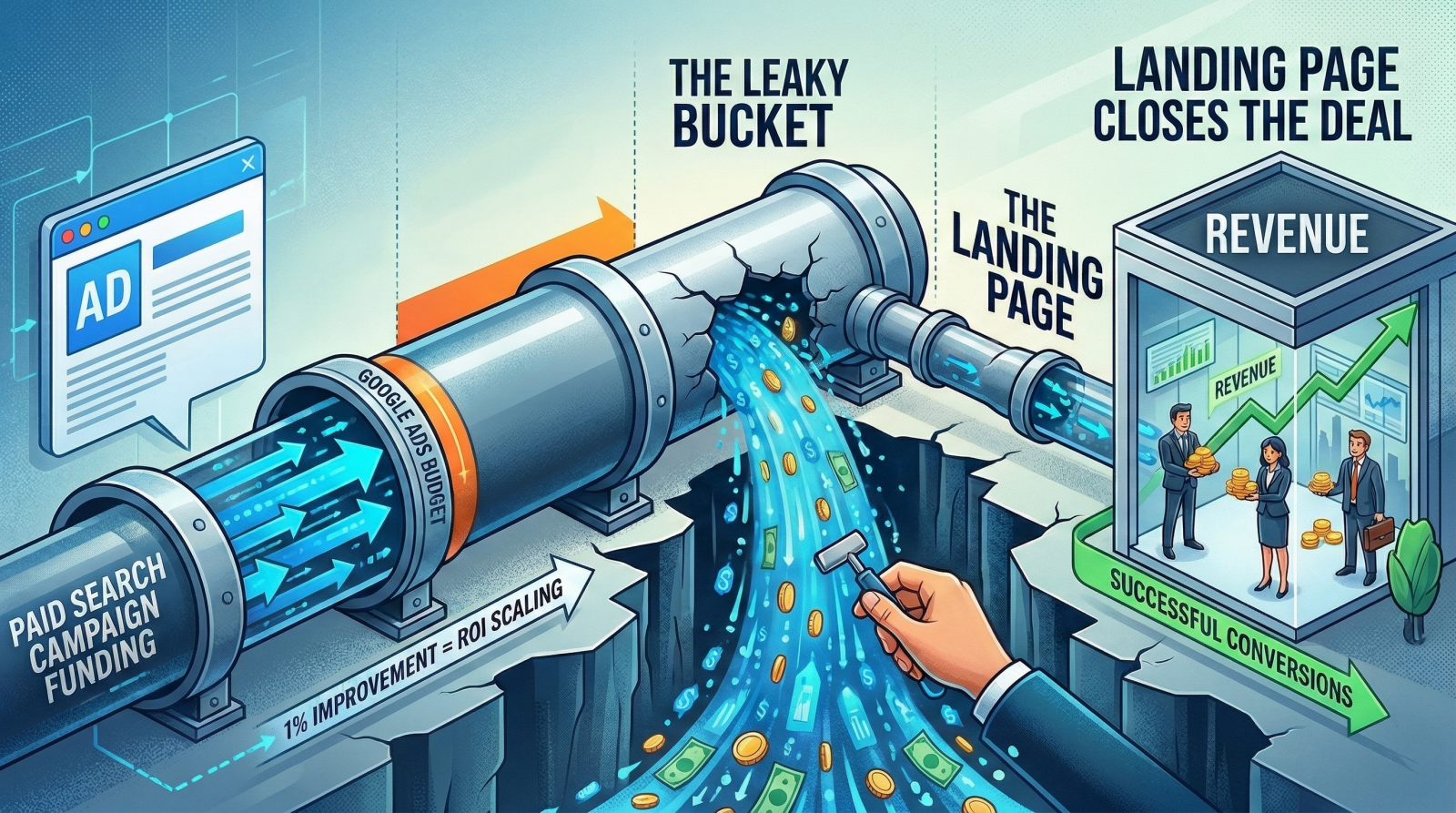
The ad earns the click but the landing page closes the deal. In most accounts, the landing page is where investment quietly drains away before it ever becomes a customer.
This is about the part of your paid search funnel you fully control.
Think of a paid search campaign like giving someone directions. If any part of the route is broken, they don’t arrive.
Every successful search campaign follows the same three steps, and each one is a promise:
Most businesses optimize the ad and forget the destination. That’s a perfect GPS that gets someone to the right neighborhood but gives no house number. Close doesn’t convert.
A homepage is a generalist. It speaks to everyone: existing clients, job seekers, new clients, so it gives a clear path to no one.
A dedicated landing page is a specialist. It picks up exactly where your ad left off.
Message match is the alignment between what your ad promises and what your landing page delivers the moment someone arrives. It’s the most important concept in landing page optimization and the most consistently overlooked.
It also has a direct cost implication. Google evaluates your landing page every time your ad runs, as part of its Quality Score calculation. A weak connection between your ad and your page lowers your Landing Page Experience rating, which raises your Cost-Per-Click.
Poor message match means you pay more per click and convert fewer of them, a double loss on every dollar spent.
A well-matched page doesn’t just improve conversions. It can lower what Google charges you to show your ads at all.
The wrong turn: Ad says “Free Roof Inspection.” Landing page says “Welcome to ABC Roofing, Serving Texas Since 1998.” The visitor feels lost and leaves in three seconds.
The right turn: Ad says “Free Roof Inspection.” Landing page headline says “Schedule Your Free Roof Inspection in Dallas.“
Tip: Match the intent, not just the keywords. The headline should be well written, not like someone stuffed a search term into a sentence. Keyword-stuffed headlines can trigger Google’s editorial flags and undermine the trust you’re paying to build.
Above the fold is the content visible before anyone scrolls. For the 60%+ of visitors on mobile, that first screen is often your only chance.
Three things must live there:
Your visitors aren’t exploring. They’re narrowing a shortlist. They’ve already Googled the problem, scanned a competitor’s site, and checked Reddit.
They arrive mid-journey, not at the beginning.
They don’t need an introduction to your industry. They need a reason to stop searching.
Your page must answer the questions every visitor arrives with, even if they never ask them out loud:
Not every visitor who clicks your ad is ready to buy today. Rather than forcing a “convert or leave” moment; which spikes your bounce rate and signals to Google that your page wasn’t a good match, offer one low-friction alternative that keeps them on your site instead of sending them back to search results.
A couple options that work:
When a ready-to-leave visitor finds something worth staying for, dwell time goes up. That signals relevance to Google; and relevance lowers your Cost-Per-Click.
But keep it secondary. This is a fine line.
If your newsletter signup is more prominent than your primary CTA, you’re paying Google to build your email list instead of your client roster. A secondary path should feel secondary, a text link or ghost button, not a competing headline. Your primary CTA should pop. Everything else should recede.
When in doubt, test it. If adding a downloadable guide drops your audit requests by more than 5%, the guide is a distraction, not an asset. Data beats intuition every time.
The landing page is the most controllable variable in your paid search funnel — and the most neglected. A 1% improvement in conversion rate can turn a campaign that barely breaks even into one that scales your business.
Traffic without conversion isn’t growth. It’s just spending
Book Your Free 20-Minute Growth Chat